






Persistent emotional state for AI agents.
Appraise a message, update the state, let it decay, and get a prompt block, style parameters and a memory decision back.
Part of Project NHE.
What it does
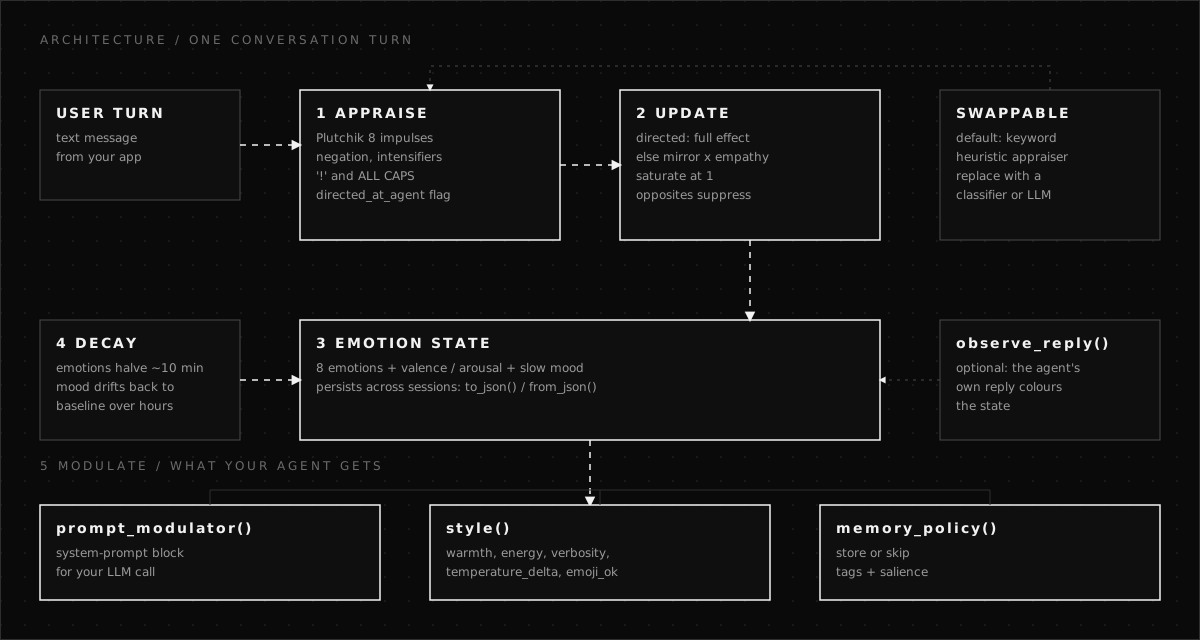
Elysium X 20 sits between the user and your LLM. It keeps a persistent emotional state, nudges it with every conversation turn, lets it fade over time, and hands you three things to act on:
| Output | What you get |
|---|---|
prompt_modulator() |
a system-prompt block describing the current state |
style() |
warmth, energy, verbosity, temperature_delta, emoji_ok |
memory_policy() |
whether to store this turn, with tags and a salience score |
No dependencies. Pure Python.
Demo
Real output of examples/companion_loop.py (abridged). The LLM call in that example is a stub.
Architecture
Philosophy
- Functional, not claimed. The engine models a state that changes behaviour. It makes no claim that an agent "really feels". Your product decides how to describe that to users.
- State, not vibes in the prompt. Most companions fake emotion by writing "be warm" in the system prompt. Here emotion is data: it accumulates, decays, has a slow mood, and persists across sessions.
- Transparent and swappable. The default appraiser is a small word-list heuristic you can read in one file. Replace it with a classifier or an LLM call without touching the rest.
- Emotion shapes memory. Charged moments are worth remembering. The engine tells you which ones.
Install
pip install elysium-x20          # once published to PyPI
pip install git+https://github.com/itsppm76/elysium-x20   # or from the repo
pip install -e .                 # from a clone
Quick start
from elysium_x20 import EmotionEngine, Personality

engine = EmotionEngine(Personality(empathy=0.7))

engine.process_turn("I passed my exam!! so happy")     # feel the user's message
system = BASE_PROMPT + "\n\n" + engine.prompt_modulator("Nova")
reply = my_llm(system, user_msg)
engine.observe_reply(reply)                              # optional: reply colours state

decision = engine.memory_policy()                        # remember this turn?
if decision.store:
    save_memory(user_msg, tags=decision.tags, salience=decision.salience)

engine.style()            # warmth / energy / verbosity / temperature_delta / emoji_ok
engine.to_json()          # persist; EmotionEngine.from_json(...) to restore
See examples/companion_loop.py for a runnable loop.
How it works
- Appraise. The message becomes emotional impulses over Plutchik's eight emotions (joy, trust, fear, surprise, sadness, disgust, anger, anticipation). Negation, intensifiers,
!and ALL CAPS are handled. Text aimed at the agent ("you are useless", "thank you") is flaggeddirected_at_agent. - Update. Directed feelings hit the agent fully. Otherwise the user's emotion is mirrored in proportion to
Personality.empathy(user sadness gives the agent some sadness plus trust, user anger gives mild unease, not anger). Updates saturate at 1 and suppress the opposite emotion (joy vs sadness, fear vs anger, ...). - Core affect. Valence and arousal are derived from the emotions and blended with a slow mood.
- Decay. Emotions halve every ~10 minutes (scaled by
emotional_stability); mood drifts back tobaseline_valenceover hours. Time is injectable (now=), so behaviour is deterministic and testable. - Modulate.
prompt_modulator(),style()andmemory_policy()turn the state into things your agent can use.
Plugging in a better appraiser
from elysium_x20 import Appraisal, EmotionEngine

class MyAppraiser:
    def appraise(self, text: str) -> Appraisal:
        scores = my_classifier(text)             # {"joy": 0.7, ...}
        return Appraisal(impulses=scores, directed_at_agent=False)

engine = EmotionEngine(appraiser=MyAppraiser())
Honest limitations
- The built-in appraiser is a keyword heuristic: English only, no sarcasm, no context beyond a 3-word window. It is a baseline, not a state-of-the-art emotion recognizer.
- The numbers (half-lives, mirroring factors, thresholds) are hand-tuned defaults, not fitted to human data. No benchmarks are claimed. Tune them for your product.
- It is not a safety system and not a mental-health tool. Do not use it to detect crises or to manipulate users' emotions.
Roadmap
- Elysium X 20 FR: a trained appraisal model for this interface. Not released yet; this repo contains no trained weights.
- Multilingual lexicons, per-user relationship memory, an optional LLM-based appraiser.
Development
pip install -e ".[dev]"
pytest
License
MIT. See LICENSE.
ELYSIUM X 20 / PROJECT NHE / MIT
Inference Providers NEW
This model isn't deployed by any Inference Provider. 🙋 Ask for provider support