

OpenToolSearch Rerank 0.6B
A small reranker that picks the right tools for a request. Developed by AI3 Inc.
Agents now carry hundreds or thousands of tool definitions (function declarations, MCP tools). Putting all of them in the prompt costs tokens and makes the model choose worse. Tool search fixes that: keep the library out of the prompt, find the few tools a request needs, load only those. Model APIs have started to offer this on the server side; OpenToolSearch is the open version you run yourself, with any model.
This repository is the second stage of that search: a 0.6B cross-encoder that reads a request next to a tool definition and scores how well the tool fits.
| Developed by | AI3 Inc. |
| Model type | Cross-encoder reranker (yes/no head of a causal LM) |
| Base model | Qwen/Qwen3-Reranker-0.6B |
| Parameters | 0.6B (bfloat16, 1.2 GB) |
| First stage | ai3inc/opentoolsearch-embed-0.6b (ours, 0.6B); any retriever works |
| Language | English; tested on Korean requests (one set, see Results) |
| Licence | Apache-2.0 |
Highlights
- Fast and cheap. With its first-stage embedder: 0.10 s per search and $0.19 per 1,000 on one GPU (37,000 searches an hour; a single request takes a median 66 ms) - 25-120 times faster than the hosted tool search of Google, OpenAI and Anthropic, and 90-330 times cheaper than the flagship ones.
- Open weights, your hardware. 1.2B parameters in all (0.6B embedder, 0.6B reranker), both Apache-2.0; your tool library never leaves your machines.
- Competitive on quality. On the public benchmark the pair beats OpenAI's and Claude's hosted tool search and Gemini 3.6-flash, ties Gemini 3.8-flash and trails gemini-4-hydrogen by 2.7 points; on our own set and in Korean it is level with or above every hosted tool search. Tool-DE, an 8B open pair, scores higher, mostly through its 4B reranker (Tool-Rank-4B behind our embedder: 71.8 / 90.8 / 90.8, at 2.6 times the time); behind a bigger first stage (callbus-emb-8b) this reranker reaches 71.8 / 89.4 / 89.0.
- English first, Korean tested. The reranker was trained and benchmarked mainly in English; Korean requests over English tool descriptions cost the pair 0.8 points. Other languages were not evaluated.
- Second among published systems on ToolRet's whole corpus (58.4 nDCG@10, question + instruction, 44,453 tools) - measured with NVIDIA's 1.14B Nemotron-3-Embed-1B as first stage, the default before version 0.2; the new default pair was not run on that setting.
Benchmarks
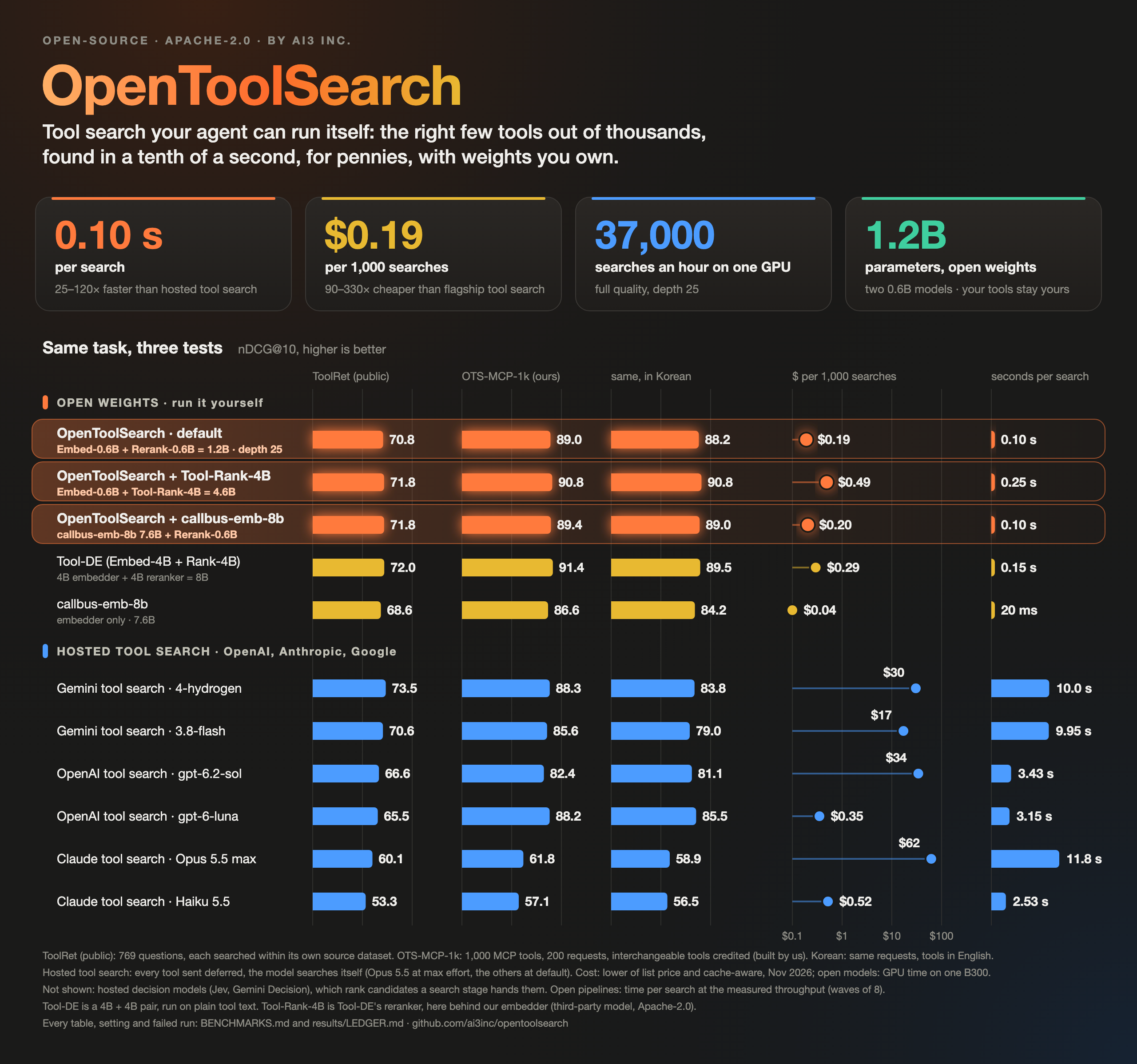
| System | Kind | ToolRet (public) | OTS-MCP-1k (ours) | …in Korean | Cost / 1,000 searches | Median latency |
|---|---|---|---|---|---|---|
| Gemini tool search · gemini-4-hydrogen | hosted tool search | 73.5 | 88.3 | 83.8 | $30 (list $51) | 10.0 s |
| Tool-DE (4B + 4B) | open weights | 72.0 | 91.4 | 89.5 | $0.29 | 0.15 s |
| OpenToolSearch (callbus-emb-8b 7.6B + Rerank-0.6B) | open weights; our reranker, callbus's embedder | 71.8 | 89.4 | 89.0 | $0.20 | 0.10 s |
| OpenToolSearch (Embed-0.6B + Tool-Rank-4B = 4.6B) | open weights; our embedder, Tool-DE's reranker | 71.8 | 90.8 | 90.8 | $0.49 | 0.25 s |
| OpenToolSearch (Embed-0.6B + Rerank-0.6B = 1.2B) | open weights, this repo | 70.8 | 89.0 | 88.2 | $0.19 | 0.10 s |
| Gemini tool search · gemini-3.8-flash | hosted tool search | 70.6 | 85.6 | 79.0 | $17 (list $28) | 9.95 s |
| callbus-emb-8b (8B, embedding only) | open weights | 68.6 | 86.6 | 84.2 | $0.04 | 0.02 s |
| OpenAI tool search · gpt-6.2-sol | hosted tool search | 66.6 | 82.4 | 81.1 | $34 | 3.43 s |
| OpenAI tool search · gpt-6-luna | hosted tool search | 65.5 | 88.2 | 85.5 | $0.35 (list $1.74) | 3.15 s |
| Claude tool search · Opus 5.5 max effort | hosted tool search | 60.1 | 61.8 | 58.9 | $62 | 11.8 s |
| Claude tool search · Haiku 5.5 | hosted tool search | 53.3 | 57.1 | 56.5 | $0.52 | 2.53 s |
nDCG@10. ToolRet (public): 769 questions, each searched within its own source dataset, the benchmark's labels, request only. OTS-MCP-1k: 1,000 MCP tools and 200 requests, built by us - weigh it below the public one. In Korean: the same requests, tools in English. Hosted costs are the lower of list price and cache-aware, from reported token usage (Nov 2026); open models are GPU time on one B300. Hosted decision models (Jev, Gemini Decision) are not in the table: they rank the candidates a search stage hands them and cannot search a library themselves.
Every system, setting and failed run: github.com/ai3inc/opentoolsearch and the ledger.
Built for big tool libraries that keep changing
Hundreds or thousands of MCP tools and skills, new ones every day: the index lives in your process and stays current almost for free. On a
1,000-tool library (one B300, real models, pip install from GitHub): add or change a tool 16-17 ms (only that tool is embedded), remove it under 1 ms,
re-scan after 35 edits, 5 additions and 5 removals 143 ms (40 texts embedded; a full rebuild is 0.9 s), save / load the index 14 ms / 4 ms. The kept-current
index returns the identical top 5 as a rebuilt one for 200 of 200 requests. Only the top 5 definitions (about 590 tokens, against 118,000 for the whole library)
go to your model, at 0.10 s and $0.19 per 1,000 searches with the reranker - no vector database, no nightly job, tool descriptions never leave your process.
A hosted decision model (Jev, Gemini Decision) cannot do this: it ranks candidates it is given, reads a whole pool only up to about 200 tools and holds no index -
OpenToolSearch finds the candidates, a decision model can make the last choice. Skills were checked only on a small private set; details, limits and the
measurements: README and
BENCHMARKS.
Use
With transformers only
import torch
from transformers import AutoModelForCausalLM, AutoTokenizer

name = "ai3inc/opentoolsearch-rerank-0.6b"
tok = AutoTokenizer.from_pretrained(name, padding_side="left")
model = AutoModelForCausalLM.from_pretrained(name, torch_dtype=torch.bfloat16).eval()
yes, no = tok.convert_tokens_to_ids("yes"), tok.convert_tokens_to_ids("no")

PRE = ('<|im_start|>system\nJudge whether the Document meets the requirements based on the Query and the '
       'Instruct provided. Note that the answer can only be "yes" or "no".<|im_end|>\n<|im_start|>user\n')
SUF = "<|im_end|>\n<|im_start|>assistant\n<think>\n\n</think>\n\n"
DEFAULT = "Given a user request, retrieve the tools that are needed to fulfil it"

def score(request, tool_json, instruction=None):
    text = f"{PRE}<Instruct>: {instruction or DEFAULT}\n<Query>: {request}\n<Document>: {tool_json}{SUF}"
    ids = tok(text, return_tensors="pt", add_special_tokens=False).to(model.device)
    with torch.no_grad():
        logits = model(**ids).logits[0, -1]
    return (logits[yes] - logits[no]).item()          # higher = better fit

tool = '{"name": "get_weather_forecast", "description": "Get the weather forecast for a city on a given date."}'
print(score("What's the weather in Seoul tomorrow?", tool))
With the OpenToolSearch library
Index, fused two-stage search, and a drop-in tool_search function for deferred tool loading:
github.com/ai3inc/opentoolsearch
(pip install git+https://github.com/ai3inc/opentoolsearch). The repository also holds the
evaluation and training code behind every number on this page.
from opentoolsearch import ToolIndex

index = ToolIndex()                               # ai3inc/opentoolsearch-embed-0.6b + this reranker
index.add(tools)                                  # OpenAI / Anthropic / Gemini / MCP style dicts
hits = index.search("refund the customer's last order", k=5)

# Deferred loading: give the model one function instead of the whole library
search_tool = index.search_tool()                 # declaration of `tool_search`
loaded = index.handle(call_arguments)             # full declarations of the best matches
instruction is optional: one line saying what kind of tool is needed, in ToolRet's style
("Given a weather task, retrieve tools that return a forecast for a location and date").
An agent can write it itself when it calls tool_search.
Recommended pipeline. Embed every tool once with the first-stage model, take the top 25 for a
request (the library default), score those with this model, and rank by
z(rerank) + 0.5 * z(first stage). Reranking 50 candidates is about as good (70.8 against 70.5 on
the public benchmark, behind the earlier Nemotron first stage) at half the speed; 10 is faster still and
3 points lower.
How it was made
- Fine-tuned from
Qwen/Qwen3-Reranker-0.6Bfor 300 steps of 48 groups (one relevant tool + seven hard negatives; listwise cross-entropy plus a pointwise term), learning rate 6e-6, on one NVIDIA B300. - Weight-averaged 50/50 with the released base model. On ToolRet the average scores 55.98 on its own, the fine-tuned weights 51.68 and the base 51.85. The ratio was fixed at 0.5 beforehand.
- Layout augmentation. Tool libraries write the same tool in many layouts. During training every tool definition was re-rendered in a random one (renamed and reordered keys, wrapped or unwrapped, JSON / YAML-like / Python signature), so that the model cannot learn "tools that look like my training set are the relevant ones". Without this, fine-tuning raised scores on the training sources and lowered them everywhere else.
- Hard negatives are the first-stage model's own top results for each training question.
Training data
| Source | Rows | Notes |
|---|---|---|
| ToolRet-Training-20w (ToolBench, APIGen, ToolACE) | 188,404 used of 208,826 | 18,422 rows removed because the question copies or nearly copies a ToolRet test question (normalised exact match, word-set Jaccard >= 0.60, or embedding cosine >= 0.92); 2,000 more held out |
| Toucan-1.5M (real MCP-server tools) | 64,510 | Apache-2.0; same near-copy filter |
| Glaive function-calling v2 | 17,032 | Apache-2.0; same near-copy filter |
The retrieval instructions for the Toucan and Glaive rows were written by an LLM in ToolRet's style. No ToolRet test question or test label was used for training. Only 14,400 groups were sampled from this pool, so the model has seen a small part of it.
Limits
- Trained on English. Korean requests over English tools were tested on one set (88.2 nDCG@10 behind OpenToolSearch Embed against 89.0 in English); other languages were not evaluated.
- Evaluated on ToolRet and on one validation set of our own. Both are built from research and synthetic datasets; neither is the traffic of a live agent.
- A cross-encoder runs once per candidate. Budget for 25-50 forward passes per search; the first-stage embedder decides what it gets to see.
- When a library holds several near-identical tools from different providers, nothing in a request says which one is "right"; rankings among those are arbitrary.
- ToolRet's datasets state no licence. The training set above is public on the Hugging Face Hub, but we make no claim about the terms of the underlying source datasets.
Licence and credits
Weights: Apache-2.0, as the base model Qwen/Qwen3-Reranker-0.6B (Alibaba Cloud), which this
model modifies. The first stage, ai3inc/opentoolsearch-embed-0.6b,
is a separate repository, also Apache-2.0.
ToolRet: Shi et al., "Retrieval Models Aren't Tool-Savvy: Benchmarking Tool Retrieval for Large Language Models", ACL 2025 Findings (arXiv 2503.01763). Toucan-1.5M: Agent-Ark. Glaive function-calling v2: Glaive AI.
@misc{opentoolsearch2026,
  title  = {OpenToolSearch: small open models for tool retrieval},
  author = {AI3 Inc.},
  year   = {2026},
  url    = {https://huggingface.co/ai3inc/opentoolsearch-rerank-0.6b}
}
- Downloads last month
- 191