

TACIT: Transformation-Aware Capturing of Implicit Thought
Paper
• 2602.07061 • Published
Error code: TooBigContentError
Need help to make the dataset viewer work? Make sure to review how to configure the dataset viewer, and open a discussion for direct support.
image image |
|---|
Transformation-Aware Capturing of Implicit Thought
A programmatic visual reasoning benchmark for evaluating generative and discriminative capabilities of multimodal models across 10 tasks and 6 reasoning domains.
Author: Daniel Nobrega Medeiros | arXiv paper | GitHub
TACIT presents visual puzzles that require genuine spatial, logical, and structural reasoning — not pattern matching on text. Each puzzle is generated programmatically with deterministic seeding, ensuring full reproducibility. Evaluation is programmatic (no LLM-as-judge): solutions are verified through computer vision algorithms (pixel sampling, SSIM, BFS path detection, color counting).
All examples below show medium difficulty puzzles at 512px resolution.


Navigate through multiple maze layers connected by portals (colored dots).


Identify the missing panel in a 3×3 matrix governed by transformation rules.

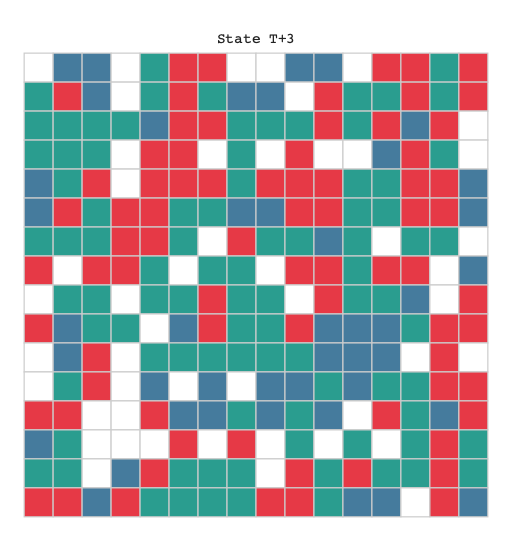
Given a rule and initial state, predict the next state of a cellular automaton.


Given an initial and final state, identify which rule was applied.

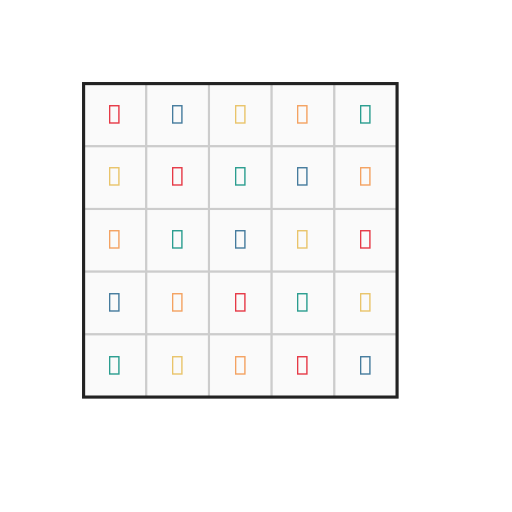
Complete a constraint-satisfaction grid using visual clues.


Color graph nodes so no adjacent nodes share the same color.


Determine whether two graphs have the same structure despite different layouts.


Determine whether a knot diagram can be untangled into a simple loop.


Match a 3D object to its correct orthographic projection views.


Reconstruct a 3D isometric view from orthographic projections.
| # | Task | Domain | Easy | Medium | Hard |
|---|---|---|---|---|---|
| 01 | Multi-layer Mazes | Spatial Reasoning | 8×8, 1 layer | 16×16, 2 layers, 2 portals | 32×32, 3 layers, 5 portals |
| 02 | Raven's Progressive Matrices | Abstract Reasoning | 1 rule | 2 rules | 3 rules, compositional |
| 03 | Cellular Automata Forward | Causal Reasoning | 8×8, 1 step | 16×16, 3 steps | 32×32, 5 steps |
| 04 | Cellular Automata Inverse | Causal Reasoning | 8×8, 4 rules | 16×16, 8 rules | 32×32, 16 rules |
| 05 | Visual Logic Grids | Logical Reasoning | 4×4, 6 constraints | 5×5, 10 constraints | 6×6, 16 constraints |
| 06 | Planar Graph k-Coloring | Graph Theory | 6 nodes, k=4 | 12 nodes, k=4 | 20 nodes, k=3 |
| 07 | Graph Isomorphism | Graph Theory | 5 nodes | 8 nodes | 12 nodes |
| 08 | Unknot Detection | Topology | 3 crossings | 6 crossings | 10 crossings |
| 09 | Orthographic Projection | Spatial Reasoning | 6 faces | 10 faces, 1 concavity | 16 faces, 3 concavities |
| 10 | Isometric Reconstruction | Spatial Reasoning | 6 faces | 10 faces, 1 ambiguity | 16 faces, 2 ambiguities |
Each task has 200 puzzles per difficulty level (easy / medium / hard) = 600 per task, 6,000 total.
The model receives a puzzle image and must produce a solution image (e.g., a solved maze, colored graph, completed matrix). Verification is fully programmatic using computer vision:
| Task | Verification Method |
|---|---|
| Maze | BFS path detection on rendered solution |
| Raven | SSIM comparison (threshold 0.997) |
| CA Forward / Inverse | Pixel sampling of cell states |
| Logic Grid | Pixel sampling of grid cells |
| Graph Coloring | Occlusion-aware node color sampling |
| Graph Isomorphism | Color counting + structural validation |
| Unknot | Color region counting |
| Ortho Projection | Pixel sampling of projection views |
| Iso Reconstruction | SSIM comparison (threshold 0.99999) |
The model receives a puzzle image plus 4 distractor images and 1 correct solution, and must identify the correct answer. This is a 5-way multiple-choice visual task.
snapshot/
├── metadata.json              # Generation config and parameters
├── README.md                  # This file
├── task_01_maze/
│   ├── task_info.json         # Task parameters
│   ├── easy/
│   │   ├── 512/               # 512px resolution
│   │   │   ├── puzzle_0000.png
│   │   │   ├── solution_0000.png
│   │   │   ├── distractors_0000/
│   │   │   │   ├── distractor_00.png
│   │   │   │   ├── distractor_01.png
│   │   │   │   ├── distractor_02.png
│   │   │   │   └── distractor_03.png
│   │   │   ├── puzzle_0001.png
│   │   │   ├── solution_0001.png
│   │   │   ├── distractors_0001/
│   │   │   │   └── ...
│   │   │   └── ... (200 puzzles)
│   │   ├── 1024/              # 1024px resolution
│   │   │   └── ... (same structure)
│   │   └── 2048/              # 2048px resolution
│   │       └── ... (same structure)
│   ├── medium/
│   │   └── ... (same structure)
│   └── hard/
│       └── ... (same structure)
├── task_02_raven/
│   └── ...
└── ... (10 tasks total)
puzzle_NNNN.png — the input puzzle imagesolution_NNNN.png — the ground-truth solution (Track 1 target)distractors_NNNN/distractor_0X.png — 4 wrong answers (Track 2 candidates)| Metric | Value |
|---|---|
| Total puzzles | 6,000 |
| Total PNG files | 108,008 |
| Resolutions | 512, 1024, 2048 px |
| Difficulties | easy, medium, hard |
| Distractors per puzzle | 4 |
| Dataset size | ~3.9 GB |
| Generation seed | 42 |
from datasets import load_dataset

# Load full dataset
ds = load_dataset("tylerxdurden/TACIT-benchmark")

# Or download specific files
from huggingface_hub import hf_hub_download

puzzle = hf_hub_download(
    repo_id="tylerxdurden/TACIT-benchmark",
    filename="task_01_maze/easy/1024/puzzle_0000.png",
    repo_type="dataset",
)
from tacit.registry import GENERATORS

# Regenerate a specific puzzle (deterministic)
gen = GENERATORS["maze"]
puzzle = gen.generate(seed=42, difficulty="easy", index=0)

# Verify a candidate solution (Track 1)
is_correct = gen.verify(puzzle, candidate_png=model_output_bytes)
See the GitHub repository for full evaluation documentation.
The 10 tasks span 6 reasoning domains, chosen to probe different aspects of visual cognition:
@misc{medeiros_2026,
    author       = {Daniel Nobrega Medeiros},
    title        = {TACIT-benchmark},
    year         = 2026,
    url          = {https://huggingface.co/datasets/tylerxdurden/TACIT-benchmark},
    doi          = {10.57967/hf/7904},
    publisher    = {Hugging Face}
}
Apache 2.0