Attractor Dynamics in LLM is an extremely abstract theory - if not philosophy. But finally, AI is able to build up a solid engineering framework based on these abstract concepts. This framework synthesize several things that are genuinely scattered across different sources and rarely combined cleanly:
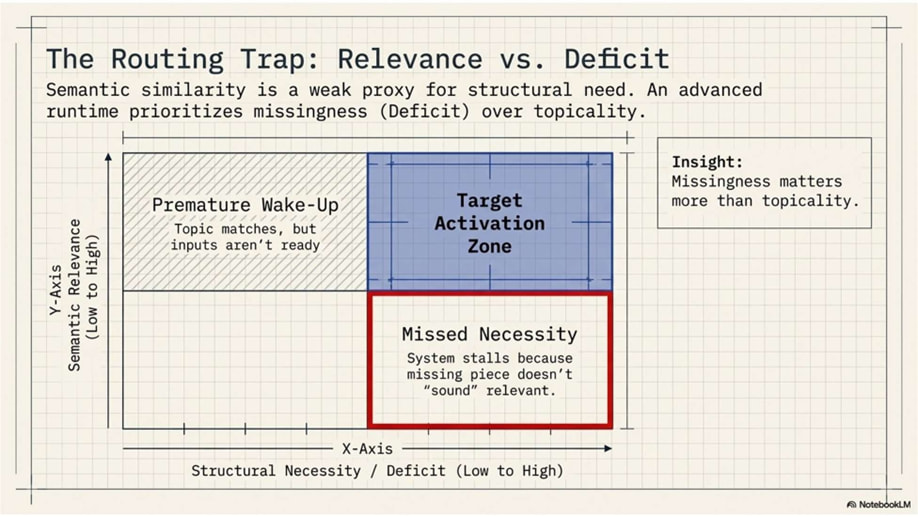
- The deficit-led routing idea (route by what’s missing, not what’s nearby) is underrepresented in most production frameworks, which still lean heavily on semantic similarity
- The skill cell schema (regime, phase, input/output contracts, wake mode, failure states) is more complete than what most frameworks give you out of the box — LangGraph gives you nodes and edges, not a structured capability contract
- The coordination episode as the natural clock rather than tokens or turns is a genuinely cleaner abstraction that most frameworks don’t explicitly surface
- The traces over screenshots engineering norm is said everywhere but rarely architecturally enforced the way this document proposes
- The incremental rollout path (exact cells first, Bosons last) is practical advice that contradicts how most tutorials present agent frameworks
An full entry level tutorial “From Agent Theater to Runtime Physics_An Illustrated Study Guide to the Coordination-Cell Framework for AI Systems.pdf” with detail explanatory notes can be found in Open Science Framework web site.
This framework opened a small window for AI Engineers to observe Semantic Attractor Dynamics/Topology - which I bet will become AGI development focus very soon.
Slide 1 — From Agent Theater to Runtime Physics
Slide 2 — The Hidden Cost of “Just Add Another Agent”
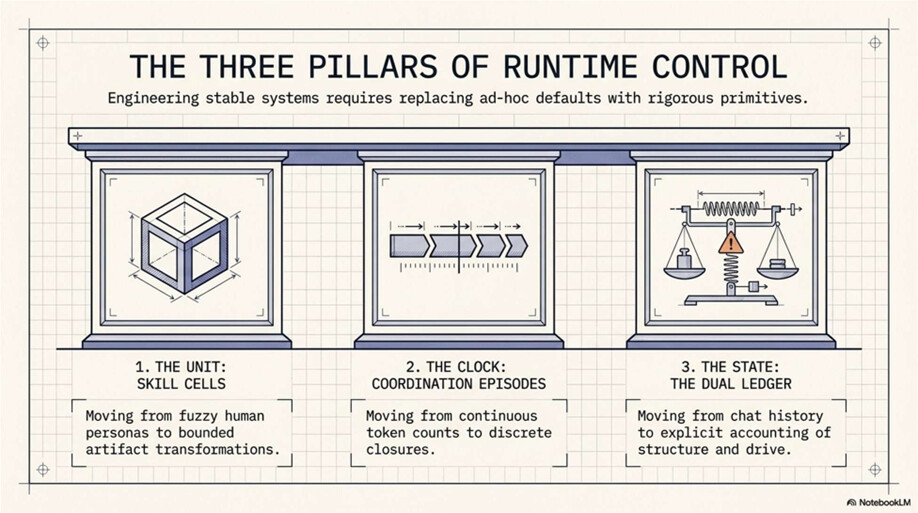
Slide 3 — The Three Pillars of Runtime Control
Slide 4 — Capability Is Defined by Transformation, Not Persona
Slide 5 — Anatomy of a Bounded Skill Cell
Slide 6 — The Routing Trap: Relevance vs. Deficit
Slide 7 — Transient Signals: The Semantic Boson Layer
Slide 8 — From Token-Time to Coordination Episodes
Slide 9 — The Minimal Runtime Loop
Slide 10 — The Dual Ledger: Governing System State
Slide 11 — Mass, Rigidity, and System Telemetry
Slide 12 — Environment Drift and Robust Mode
Slide 13 — Traces Greater Than Screenshots
Slide 14 — The Incremental Implementation Path
Slide 15 — The Ultimate Paradigm Shift
2 Likes
hmm.
i like your presentation on ‘just add another agent’
in my own workflow, i utilize several agents. some have specific reasons for being included.
and i have observed soemthing you have all but stated implicitly. Roles must be DEFINED and FRAMED in a multi-Agent workflow. it is not enough to give them ‘Role names’ an name is just a name, it is not always a concept.
so for a ‘role’ to have any meaning, it must be defined, and therfor a framework derived. Much like asking an actor to present themselfs as a historical figure… without knowledge of the figure in question, they are acting in name only.
and the incrememntal Incrementation Path -
smaller elements - more clarity. combining smaller elements = structural Clarity. basically, starting small alows one to adequitely define each state. this alows you to test outputs at each stage. if the state is too large, then failiers are not easily traceable. but if the state is derifed from smaller - well defined states, then the failier is earier to trace, and thus re-alignment is easier.
i feel like there is a universal law hiding here, along the lines of starting small with incremental steps.
but i offer these inputs only as observations.
the images here are doing A LOT of work. and there is alot to take in.
2 Likes